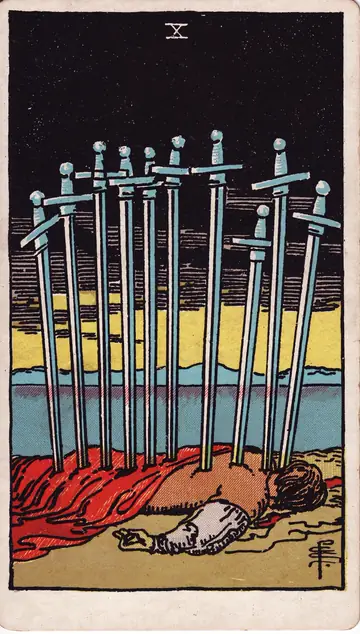
Ten of Swords: yes or no?
Ten of Swords is a no upright and a no reversed. Ten of Swords usually reads as a no, or not yet: it points to something to face or wait out first.
| Upright | No |
|---|---|
| Reversed | No |
| Keywords | endings, rock bottom, release, exhaustion, new dawn |
| Element | Air |
| Arcana | Minor Arcana |
Why Ten of Swords leans no
In a one-card reading, a card that leans no points to something to face, finish or wait out first: not never, but not like this or not yet. The Ten of Swords leans no. It points to an ending and pain. Reversed, it can lean toward yes as recovery begins.
Ten of Swords upright as an answer
Upright, Ten of Swords speaks of an ending that finally lets you begin again; the worst is behind you. The Ten of Swords lies under ten blades as dawn breaks on the horizon. It is the card of a painful ending or hitting the bottom, and of the fact that it can't get worse from here: a new day is coming.
Ten of Swords reversed as an answer
Reversed, the answer turns to a no: refusing to let a chapter close; moving on starts when you accept it. Reversed, recovering and getting back up.
Yes or no in love
Asked about love, upright, it leans no or not yet: something has to change, be said or be let go before the answer can turn. In love, the definite end of a pattern or a situation.
Yes or no about work and money
Asked about a job, a move or money, upright, it leans no, or not on these terms. At work, a project or role ending. Let it close. At work, the Ten of Swords can describe a painful ending: a layoff, a project failing, burnout. It's a hard card, but it says this is the bottom, and recovery starts now. With money, it can describe a financial low point, and favors accepting it and rebuilding step by step. Many people look back on a Ten of Swords time as the moment their life changed direction for the better, even if it didn't feel like it then.
As advice for your decision
Accept that this chapter has ended, and rest.
Ten of Swords with other cards
- Ten of Cups (yes on its own): An ending and a new happiness. This pair can describe a painful ending making room for a happier home or relationship.
- The Tower (no on its own): A crash. Together these cards describe a sudden, painful collapse, and the clearing that follows.
- Judgement (yes on its own): Rising again. This pair favors recovery, a second chance and a new start after hitting bottom.
How to ask a yes or no question
Ask about one thing, in words that a yes or a no can answer: "Should I take the job?" rather than "What about work?". Draw one card, read its lean, then read what the card itself says, since that tells you why the answer leans the way it does. A maybe is an answer too: it says the outcome still depends on a choice.
Ten of Swords as a yes or no: questions people ask
Is Ten of Swords a yes or no card?
Ten of Swords leans no upright, and no when it is drawn reversed. Its keywords, endings, rock bottom, release, are what that answer rests on.
What does Ten of Swords reversed mean in a yes or no reading?
Reversed, Ten of Swords reads as a no: refusing to let a chapter close; moving on starts when you accept it. A reversed card holds back what the card means upright, so its answer softens by one step.
Is Ten of Swords a yes in love?
Asked about love, upright, it leans no or not yet: something has to change, be said or be let go before the answer can turn. In love, the definite end of a pattern or a situation.