Five of Wands: yes or no?
Five of Wands is a maybe upright and a no reversed. Five of Wands usually reads as a maybe: the answer depends on what you do next. Reversed, it leans toward no.
| Upright | Maybe |
|---|---|
| Reversed | No |
| Keywords | competition, friction, debate, challenge, conflict |
| Element | Fire |
| Arcana | Minor Arcana |
Why Five of Wands leans maybe
In a one-card reading, a card that leans maybe says the answer is still open and depends on what you do next, or on something not yet settled. The Five of Wands leans no, or 'not without a struggle'. It suggests competition, friction or obstacles. Reversed, it can lean toward yes as the conflict eases.
Five of Wands upright as an answer
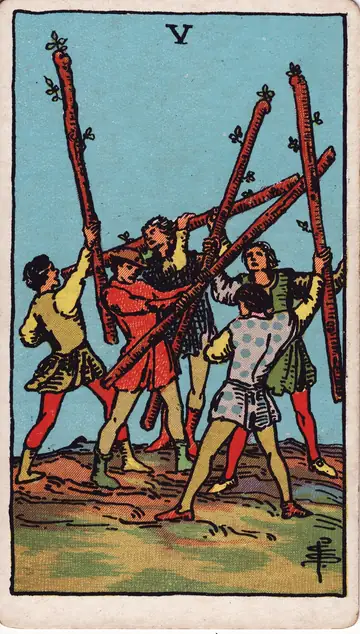
Upright, Five of Wands speaks of friction and competing views; useful if it sharpens ideas. The Five of Wands shows five people clashing with staffs. It is the card of friction and competing ideas: useful when it sharpens thinking, tiring when it is only noise. It asks whether the struggle is moving you forward.
Five of Wands reversed as an answer
Reversed, the answer turns to a no: tension easing, or conflict avoided at the cost of honesty. Reversed, tension eases, or a conflict is avoided at the cost of honesty.
Yes or no in love
Asked about love, upright, it leans maybe: the feeling may be there, and what happens depends on what each of you does next. In love, small disagreements may come up; treat them as a chance to understand each other.
Yes or no about work and money
Asked about a job, a move or money, upright, it leans maybe: worth weighing before you commit. At work, competition or debate within a team. Keep it about ideas, not people. At work, the Five of Wands points to competition, debate and clashing ideas: a team where everyone wants their way, a competitive job market, a brainstorm that gets heated. It can be productive if it sharpens ideas. With money, it can mean competing demands on your budget, or disagreements with others about money, and suggests clear agreements to keep the peace. In a job search it can describe many applicants for one role, which is a reason to sharpen your pitch, not to give up.
As advice for your decision
Choose which argument is worth your energy.
Five of Wands with other cards
- Five of Swords (no on its own): Conflict with a winner and a loser. This pair warns that an argument may turn bitter, and asks whether winning is worth what it costs.
- Seven of Wands (yes on its own): Defending your ground. Together these cards point to standing firm in a competitive situation, and suggest your position is stronger than it feels.
- Eight of Pentacles (yes on its own): Competition that sharpens skill. This pair favors using rivalry as motivation to work harder and get better at what you do.
How to ask a yes or no question
Ask about one thing, in words that a yes or a no can answer: "Should I take the job?" rather than "What about work?". Draw one card, read its lean, then read what the card itself says, since that tells you why the answer leans the way it does. A maybe is an answer too: it says the outcome still depends on a choice.
Five of Wands as a yes or no: questions people ask
Is Five of Wands a yes or no card?
Five of Wands leans maybe upright, and no when it is drawn reversed. Its keywords, competition, friction, debate, are what that answer rests on.
What does Five of Wands reversed mean in a yes or no reading?
Reversed, Five of Wands reads as a no: tension easing, or conflict avoided at the cost of honesty. A reversed card holds back what the card means upright, so its answer softens by one step.
Is Five of Wands a yes in love?
Asked about love, upright, it leans maybe: the feeling may be there, and what happens depends on what each of you does next. In love, small disagreements may come up; treat them as a chance to understand each other.