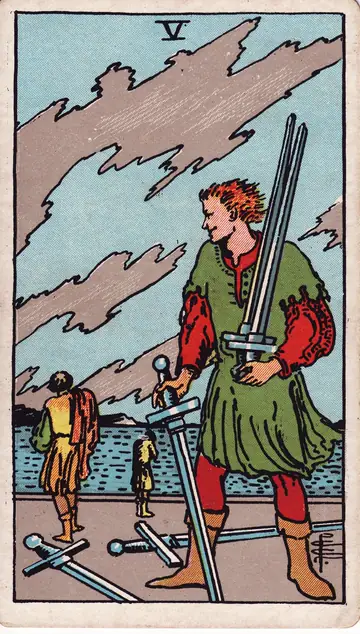
Five of Swords: yes or no?
Five of Swords is a no upright and a no reversed. Five of Swords usually reads as a no, or not yet: it points to something to face or wait out first.
| Upright | No |
|---|---|
| Reversed | No |
| Keywords | conflict, winning at a cost, tension, pride, walking away |
| Element | Air |
| Arcana | Minor Arcana |
Why Five of Swords leans no
In a one-card reading, a card that leans no points to something to face, finish or wait out first: not never, but not like this or not yet. The Five of Swords leans no. It points to conflict and hollow victories. Reversed, it can lean toward yes as peace is made.
Five of Swords upright as an answer
Upright, Five of Swords speaks of conflict where winning costs something; ask what you really want. The Five of Swords gathers blades while others walk away defeated. It is the card of conflict where winning costs more than it gains. It asks whether being right matters more than the relationship.
Five of Swords reversed as an answer
Reversed, the answer turns to a no: making peace or walking away from a pointless fight. Reversed, making peace or walking away from a fight that isn't worth it.
Yes or no in love
Asked about love, upright, it leans no or not yet: something has to change, be said or be let go before the answer can turn. In love, arguments where nobody really wins. Look for common ground.
Yes or no about work and money
Asked about a job, a move or money, upright, it leans no, or not on these terms. At work, office politics or a hollow victory. At work, the Five of Swords points to conflict, office politics or a win that costs relationships. It asks you to choose your battles. With money, it can describe a dispute, and favors fair agreements over winning at all costs. A deal that leaves the other side feeling cheated tends to cost you later, in reputation if not in money.
As advice for your decision
Ask what winning would actually cost you.
Five of Swords with other cards
- The Lovers (yes on its own): A relationship in conflict. This pair describes a love tested by arguments, and asks you to choose each other over winning.
- Five of Wands (maybe on its own): Conflict doubled. Together these cards point to heated arguments and competition, and suggest stepping back before it escalates.
- Justice (maybe on its own): A fair resolution. This pair favors settling a dispute fairly, even if it means letting go of the need to win.
How to ask a yes or no question
Ask about one thing, in words that a yes or a no can answer: "Should I take the job?" rather than "What about work?". Draw one card, read its lean, then read what the card itself says, since that tells you why the answer leans the way it does. A maybe is an answer too: it says the outcome still depends on a choice.
Five of Swords as a yes or no: questions people ask
Is Five of Swords a yes or no card?
Five of Swords leans no upright, and no when it is drawn reversed. Its keywords, conflict, winning at a cost, tension, are what that answer rests on.
What does Five of Swords reversed mean in a yes or no reading?
Reversed, Five of Swords reads as a no: making peace or walking away from a pointless fight. A reversed card holds back what the card means upright, so its answer softens by one step.
Is Five of Swords a yes in love?
Asked about love, upright, it leans no or not yet: something has to change, be said or be let go before the answer can turn. In love, arguments where nobody really wins.