Five of Swords tarot card meaning
Conflict where winning costs something; ask what you really want.
| Arcana | Minor Arcana |
|---|---|
| Suit | Swords |
| Element | Air |
| Keywords | conflict, winning at a cost, tension, pride, walking away |
| Yes or no | No |
Five of Swords: what the card shows
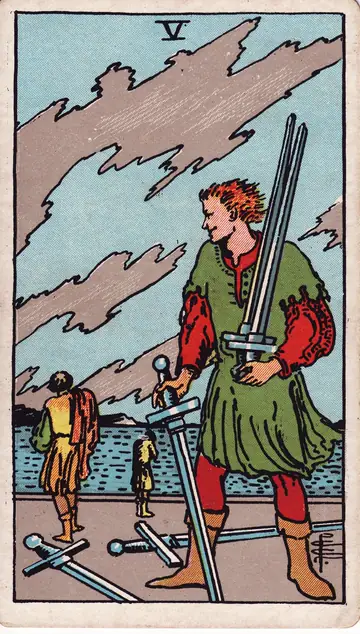
A smug young man gathers three swords from the ground, looking back over his shoulder at two figures walking away with their heads down. Two more swords lie at his feet. The sky is jagged with broken clouds. He's won, clearly, but nobody is celebrating with him. It's a picture of a hollow victory: winning the argument and losing the people. The swords he carries are more than he can use, which says something about why he wanted them.
Five of Swords upright
The Five of Swords gathers blades while others walk away defeated. It is the card of conflict where winning costs more than it gains. It asks whether being right matters more than the relationship.
Five of Swords reversed
Reversed, making peace or walking away from a fight that isn't worth it.
Reversed, the Five of Swords often means making peace after a fight, or deciding a conflict isn't worth it. You may be the one walking away this time, and feeling lighter for it. It can also mean lingering resentment, a grudge that won't fade. The card favors apologizing where you were wrong, forgiving where you can, and walking away from fights you don't need to win.
In short: making peace or walking away from a pointless fight.
Five of Swords in love
In love, arguments where nobody really wins. Look for common ground.
If you're single
If you're single, the Five of Swords can describe a messy dating scene: game-playing, someone who cares more about winning than connecting, or a breakup that ended with hurtful words. It asks you to avoid people who treat dating as a competition, and to protect your dignity. If a date turns into a debate you can't win, leaving early is a perfectly good choice.
If you're in a relationship
In a relationship, the Five of Swords points to a fight where someone wins and the relationship loses: harsh words, point-scoring, a power struggle. It asks whether winning is worth it. Apologizing, listening and choosing peace over being right often matter more than the argument. Ask what the fight is really about; it's rarely the dishes.
Five of Swords reversed in love
Reversed in love, the Five of Swords can mean reconciliation after a fight, or letting go of a grudge. It can also mean lingering resentment, the kind that resurfaces in every new argument. It favors making peace, and making it properly: name what happened, apologize for your part, and agree on what changes.
Five of Swords as feelings: how someone sees you
As feelings, the Five of Swords says someone's feelings toward you are tangled with conflict, resentment or a need to win. They may feel defensive, hurt or competitive. You might seem to them like an opponent rather than a partner right now. Underneath the defensiveness there's often hurt, and a calm, unhurried conversation may reach it. From an ex, it can mean they're still bitter about how things ended. Reversed, they may be ready to make peace.
Five of Swords at work and with money
At work, office politics or a hollow victory.
At work, the Five of Swords points to conflict, office politics or a win that costs relationships. It asks you to choose your battles. With money, it can describe a dispute, and favors fair agreements over winning at all costs. A deal that leaves the other side feeling cheated tends to cost you later, in reputation if not in money.
Five of Swords as a person
As a person, the Five of Swords describes someone competitive, combative or self-serving: the colleague who takes credit, the friend who always has to be right. They're often clever and quick, and they may not realize how their wins land on others. Reversed, the same person may be ready to apologize.
Five of Swords in a spread: past, present and outcome
When the Five of Swords is in the past, it points to a conflict that left wounds. In the present, it asks whether the fight is worth it. As the outcome, it leans toward a hollow victory or a loss unless you choose peace: walking away from a pointless fight tends to be the real win. Drawn as your card of the day, the Five of Swords asks you to let one argument go unwon, and to notice how much calmer the day feels for it.
As advice
Ask what winning would actually cost you.
As a yes or no answer
Five of Swords usually reads as a no, or not yet: it points to something to face or wait out first.
The Five of Swords leans no. It points to conflict and hollow victories. Reversed, it can lean toward yes as peace is made.
Five of Swords with other cards
- The Lovers: A relationship in conflict. This pair describes a love tested by arguments, and asks you to choose each other over winning.
- Five of Wands: Conflict doubled. Together these cards point to heated arguments and competition, and suggest stepping back before it escalates.
- Justice: A fair resolution. This pair favors settling a dispute fairly, even if it means letting go of the need to win.
Astrology and element
In the Golden Dawn tradition, Five of Swords is the first decan of Aquarius, ruled by Venus, in the element of Air.
Five of Swords: questions people ask
What does the Five of Swords mean as feelings?
As feelings, it suggests conflict, resentment or a need to win. The person may feel defensive or hurt.
Is the Five of Swords a yes or no card?
It leans no. It points to conflict. Reversed, it can lean toward yes as peace is made.
What does the Five of Swords mean for an ex?
For an ex, it often points to bitterness about how things ended, or unresolved conflict. Reversed, it can mean they're ready to make peace.
What zodiac sign is the Five of Swords?
The Five of Swords is the first decan of Aquarius, ruled by Venus, and the Golden Dawn named it the Lord of Defeat. Venus is weak in cool, detached Aquarius, which is why the card shows a victory that leaves no warmth behind.
What does the Five of Swords mean as advice?
As advice, it says ask whether winning is worth it. Let go of a fight you don't need to win, apologize where you were wrong and protect your relationships over your pride. Sometimes the strongest move is to put the sword down and walk home with the people you love.