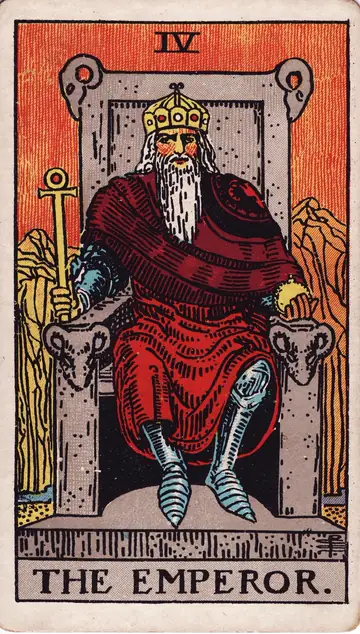
The Emperor: yes or no?
The Emperor is a yes upright and a maybe reversed. The Emperor usually reads as a yes: its energy is open and moving forward. Reversed, it softens to a maybe.
| Upright | Yes |
|---|---|
| Reversed | Maybe |
| Keywords | structure, stability, boundaries, leadership, order |
| Element | Fire |
| Arcana | Major Arcana |
Why The Emperor leans yes
In a one-card reading, a card that leans yes points to energy that is open and moving forward: the thing you are asking about has room to happen. The Emperor leans yes when your question involves taking charge, making a plan or committing to something. The answer comes with structure: yes, if you set clear terms and follow through. It's less warm about questions that depend on bending the rules.
The Emperor upright as an answer
Upright, The Emperor speaks of structure, steadiness and clear boundaries; a firm hand that protects. The Emperor sits on a stone throne: steady, organized and protective. He stands for structure that makes life work, clear boundaries, and the confidence to take charge. His card asks you to bring order to something messy and to stand behind your decisions.
The Emperor reversed as an answer
Reversed, the answer turns to a maybe: rigidity or control; loosen your grip where trust would serve better. Reversed, the Emperor can mean rigidity, control or rules held onto past their use. It asks where a firm hand helps and where trust would serve you better.
Yes or no in love
Asked about love, upright, it leans yes: a feeling returned, a step worth taking, a door that is open. In love, he points to reliability and clear agreements; it can also ask whether one person is holding all the control.
Yes or no about work and money
Asked about a job, a move or money, upright, it leans yes. At work, it favors planning, leadership and setting firm priorities. A structure you build now supports what comes later. At work, the Emperor favors leadership, management, government, law and any role with clear authority. It's a strong card for asking for the promotion, setting up a business properly, writing the plan and sticking to it. With money, it points to budgets, long-term planning and financial security built step by step, and to paying attention to contracts and rules rather than winging it.
As advice for your decision
Set one clear boundary or plan today and keep to it.
The Emperor with other cards
- The Empress (yes on its own): A classic partnership pairing. Structure meets warmth, planning meets growth, and together they describe a stable relationship or a home being built with both care and good sense.
- Death (no on its own): Authority and endings. This pair often marks the end of a regime, whether a boss leaving, a rule being retired or your own way of controlling things reaching its natural close, so that a new order can start.
- The Hierophant (yes on its own): Tradition doubled. Together these two point to institutions, rules and established paths such as a corporate career, a formal commitment or a family expectation, and they ask whether those rules still serve you.
How to ask a yes or no question
Ask about one thing, in words that a yes or a no can answer: "Should I take the job?" rather than "What about work?". Draw one card, read its lean, then read what the card itself says, since that tells you why the answer leans the way it does. A maybe is an answer too: it says the outcome still depends on a choice.
The Emperor as a yes or no: questions people ask
Is The Emperor a yes or no card?
The Emperor leans yes upright, and maybe when it is drawn reversed. Its keywords, structure, stability, boundaries, are what that answer rests on.
What does The Emperor reversed mean in a yes or no reading?
Reversed, The Emperor reads as a maybe: rigidity or control; loosen your grip where trust would serve better. A reversed card holds back what the card means upright, so its answer softens by one step.
Is The Emperor a yes in love?
Asked about love, upright, it leans yes: a feeling returned, a step worth taking, a door that is open. In love, he points to reliability and clear agreements; it can also ask whether one person is holding all the control.