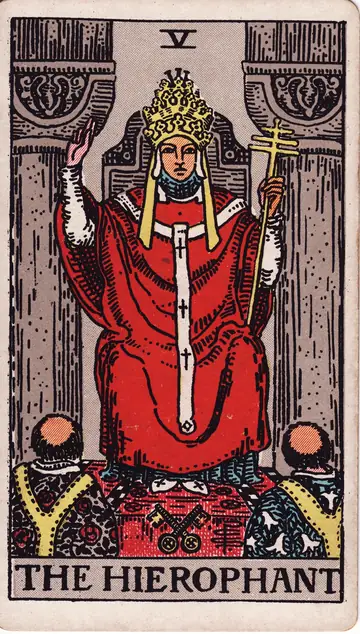
The Hierophant: yes or no?
The Hierophant is a yes upright and a maybe reversed. The Hierophant usually reads as a yes: its energy is open and moving forward. Reversed, it softens to a maybe.
| Upright | Yes |
|---|---|
| Reversed | Maybe |
| Keywords | tradition, learning, guidance, shared values, belonging |
| Element | Earth |
| Arcana | Major Arcana |
Why The Hierophant leans yes
In a one-card reading, a card that leans yes points to energy that is open and moving forward: the thing you are asking about has room to happen. The Hierophant leans yes when your question fits a conventional path or asks for guidance. It says the proven route works here. If your question is about breaking with tradition, the answer is less clear, and the reversed card speaks to that.
The Hierophant upright as an answer
Upright, The Hierophant speaks of tradition, guidance and shared values; learning from those who walked the path first. The Hierophant represents tradition, teachers and the wisdom passed between people. It speaks of learning from those who went before, of shared values, and of the comfort of belonging to something larger. It can point to a mentor, a course of study, or a familiar path that still fits.
The Hierophant reversed as an answer
Reversed, the answer turns to a maybe: rules that no longer fit; time to question the script you inherited. Reversed, it suggests that a rule or expectation no longer fits you. It invites you to question the script you inherited and to find your own way of doing things.
Yes or no in love
Asked about love, upright, it leans yes: a feeling returned, a step worth taking, a door that is open. In love, it favors commitment, shared values and traditional steps; reversed, it questions expectations that don't suit the two of you.
Yes or no about work and money
Asked about a job, a move or money, upright, it leans yes. At work, learning from someone experienced, joining an established team or following proven methods is favored. At work, the Hierophant favors established organizations, education, training, mentoring, finance, law and anything with credentials. It's a good card for going back to school, finding a mentor or following a proven process. With money, it favors traditional, low-risk choices: the retirement account, the steady employer, the advice of someone who has done it before.
As advice for your decision
Ask someone who has walked this path before you.
The Hierophant with other cards
- Temperance (yes on its own): Patience and tradition. This pair favors learning slowly and well, finding a middle way between old rules and new needs, and often points to a mentor who brings balance.
- The Lovers (yes on its own): A classic marriage pairing. Shared values meet a choice of the heart, so this combination often turns up around commitments, weddings and promises made in front of others.
- The Emperor (yes on its own): Two cards of authority. Together they suggest institutions, rules and leaders, and they can point to a choice between staying within a structure or stepping outside it.
How to ask a yes or no question
Ask about one thing, in words that a yes or a no can answer: "Should I take the job?" rather than "What about work?". Draw one card, read its lean, then read what the card itself says, since that tells you why the answer leans the way it does. A maybe is an answer too: it says the outcome still depends on a choice.
The Hierophant as a yes or no: questions people ask
Is The Hierophant a yes or no card?
The Hierophant leans yes upright, and maybe when it is drawn reversed. Its keywords, tradition, learning, guidance, are what that answer rests on.
What does The Hierophant reversed mean in a yes or no reading?
Reversed, The Hierophant reads as a maybe: rules that no longer fit; time to question the script you inherited. A reversed card holds back what the card means upright, so its answer softens by one step.
Is The Hierophant a yes in love?
Asked about love, upright, it leans yes: a feeling returned, a step worth taking, a door that is open. In love, it favors commitment, shared values and traditional steps; reversed, it questions expectations that don't suit the two of you.