The Hierophant tarot card meaning
Tradition, guidance and shared values; learning from those who walked the path first.
| Arcana | Major Arcana |
|---|---|
| Element | Earth |
| Number | V |
| Keywords | tradition, learning, guidance, shared values, belonging |
| Yes or no | Yes |
The Hierophant: what the card shows
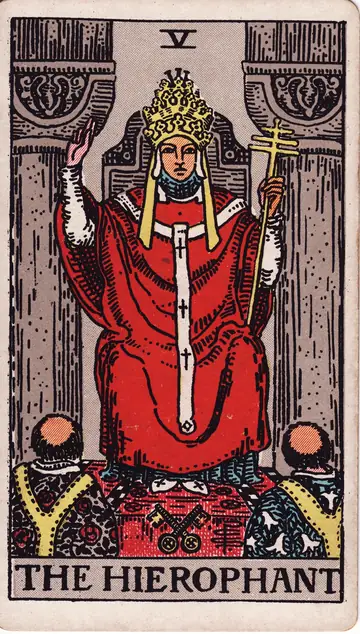
The Hierophant sits between two pillars in a church-like setting, wearing a triple crown and heavy red robes. One hand is raised in blessing; the other holds a staff topped with three crosses. Two crossed keys lie at his feet, and two figures kneel before him, waiting to be taught. It's a picture of tradition being handed down, of belonging to something with rules and a history.
The Hierophant upright
The Hierophant represents tradition, teachers and the wisdom passed between people. It speaks of learning from those who went before, of shared values, and of the comfort of belonging to something larger. It can point to a mentor, a course of study, or a familiar path that still fits.
The Hierophant reversed
Reversed, it suggests that a rule or expectation no longer fits you. It invites you to question the script you inherited and to find your own way of doing things.
Reversed, the Hierophant often marks a break with the expected path: dropping out of a program, leaving a church or a career your family chose, or questioning advice you've followed for years. That can be real growth or simple rebellion, and the card asks you to know which. It can also point to rigid rules in a group you belong to. Keep what still fits you, and let go of the rest with respect.
In short: rules that no longer fit; time to question the script you inherited.
The Hierophant in love
In love, it favours commitment, shared values and traditional steps; reversed, it questions expectations that don't suit the two of you.
If you're single
If you're single, the Hierophant favors meeting people through shared values and familiar places: a friend's introduction, your community, a class, a place of worship, your family's circle. It can describe looking for someone serious who wants the traditional steps. It may also ask whether you're following a dating script that isn't really yours.
If you're in a relationship
In a relationship, the Hierophant points to commitment and shared values: moving in, meeting the families, engagement, marriage or any step that makes the relationship official. It favors couples who share beliefs about how life should go. If you don't, it asks you to talk about those differences openly.
The Hierophant reversed in love
Reversed in love, the Hierophant questions convention. You may be in a relationship that doesn't fit the usual mold, or feeling pressure from family or friends about how love should look. It can also point to a clash of values, or to rules inside the relationship that no longer make sense.
The Hierophant as feelings: how someone sees you
As feelings, the Hierophant says someone takes you seriously and thinks of you in long-term, conventional terms. They may want to do things properly, introduce you to family, define the relationship. You strike them as trustworthy and principled, someone who would fit at their family's table on a holiday. From an ex, it can mean they still respect you but feel held back by what others think. Reversed, their feelings may be at odds with their beliefs or their family's expectations.
The Hierophant at work and with money
At work, learning from someone experienced, joining an established team or following proven methods is favoured.
At work, the Hierophant favors established organizations, education, training, mentoring, finance, law and anything with credentials. It's a good card for going back to school, finding a mentor or following a proven process. With money, it favors traditional, low-risk choices: the retirement account, the steady employer, the advice of someone who has done it before.
The Hierophant as a person
As a person, the Hierophant is a teacher, mentor or keeper of tradition: the professor, the coach, the grandparent with firm opinions, the colleague who knows how things are done. They are wise, steady and sometimes conservative. Reversed, the same person may be dogmatic, judgmental or rebellious against every rule.
The Hierophant in a spread: past, present and outcome
In the past position, the Hierophant points to the beliefs, schooling or family traditions you grew up with, and to the ways they still guide you, for better or worse. In the present, it suggests learning from someone who knows the ground, or following an established route for now. As the outcome, it leans toward formal recognition: a commitment made official, a qualification earned, a place in a group. If you'd rather break the mold, read the outcome as a question: is the conventional result the one you actually want?
As advice
Ask someone who has walked this path before you.
As a yes or no answer
The Hierophant usually reads as a yes: its energy is open and moving forward. Reversed, it softens to a maybe.
The Hierophant leans yes when your question fits a conventional path or asks for guidance. It says the proven route works here. If your question is about breaking with tradition, the answer is less clear, and the reversed card speaks to that.
The Hierophant with other cards
- Temperance: Patience and tradition. This pair favors learning slowly and well, finding a middle way between old rules and new needs, and often points to a mentor who brings balance.
- The Lovers: A classic marriage pairing. Shared values meet a choice of the heart, so this combination often turns up around commitments, weddings and promises made in front of others.
- The Emperor: Two cards of authority. Together they suggest institutions, rules and leaders, and they can point to a choice between staying within a structure or stepping outside it.
Astrology and element
In the Golden Dawn tradition, The Hierophant is linked to Taurus, a Earth sign.
The Hierophant: questions people ask
Does the Hierophant mean marriage?
It's one of the cards most often linked to marriage, because it stands for formal commitment and shared values. It doesn't promise a wedding; it suggests the relationship is moving toward something more official, or that the question of commitment is on the table.
What does the Hierophant reversed mean in a relationship?
Reversed, it can mean a relationship that breaks with convention, a clash of values, or pressure from family or culture. It asks whether the rules you're following are yours, and whether you and your partner agree on what you're building.
What zodiac sign is the Hierophant?
The Hierophant is linked to Taurus, the Earth sign ruled by Venus. Taurus values what lasts, from family customs and routines to loyalty and good craft, which matches the Hierophant's respect for what has been handed down and proven over time. It's a patient sign for a patient card.
What does the Hierophant mean in a friendship?
In a friendship, it points to loyalty, shared beliefs and a friend who acts as a mentor or guide. It can describe a friendship formed through school, work or a community. Reversed, it may suggest friends who disagree about what matters.
Is the Hierophant a good card?
It's a steady, positive card for anything that benefits from tradition, learning or commitment: school, marriage, joining an organization, finding a mentor. It feels less welcome when you want to break the rules, which is why its reversed meaning is about rebellion and finding your own way. Either way, it asks you to know which traditions are truly yours.