Three of Swords: yes or no?
Three of Swords is a no upright and a no reversed. Three of Swords usually reads as a no, or not yet: it points to something to face or wait out first.
| Upright | No |
|---|---|
| Reversed | No |
| Keywords | heartbreak, sorrow, hurt, honesty, release |
| Element | Air |
| Arcana | Minor Arcana |
Why Three of Swords leans no
In a one-card reading, a card that leans no points to something to face, finish or wait out first: not never, but not like this or not yet. The Three of Swords leans no. It points to heartbreak and pain. Reversed, it can lean toward yes as healing begins.
Three of Swords upright as an answer
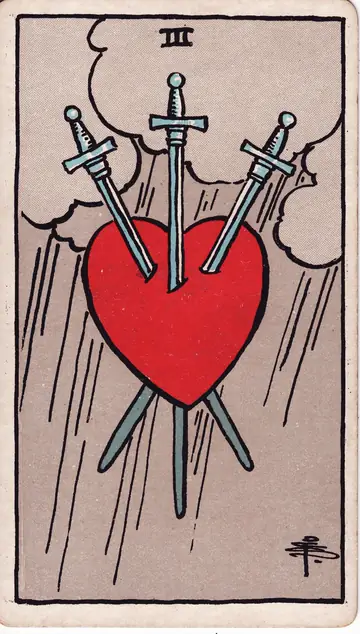
Upright, Three of Swords speaks of heartache and honest pain; naming it begins the mending. The Three of Swords shows a heart pierced by three blades under gray clouds. It is the card of hurt and sorrow, often from words or truths that sting. Acknowledging the pain is part of letting it pass.
Three of Swords reversed as an answer
Reversed, the answer turns to a no: healing after a hurt; release the story you keep repeating. Reversed, recovery begins; the hurt starts to lift.
Yes or no in love
Asked about love, upright, it leans no or not yet: something has to change, be said or be let go before the answer can turn. In love, a painful truth or disappointment. Be gentle with yourself.
Yes or no about work and money
Asked about a job, a move or money, upright, it leans no, or not on these terms. At work, criticism or a setback that stings. Learn what you can from it. At work, the Three of Swords can point to disappointment, a painful rejection or a hurtful conflict with a colleague. It asks you to process the pain and learn from it. With money, it can describe a painful loss, and favors facing it honestly rather than hiding from it. If a colleague's words stung, a calm private conversation tends to work better than letting it fester.
As advice for your decision
Let yourself feel it, then let it go.
Three of Swords with other cards
- Nine of Cups (yes on its own): A wish with a cost. This pair can describe getting what you wanted but losing something important along the way.
- Ten of Swords (no on its own): Deep pain and an ending. Together these cards describe heartbreak that marks the end of something, and the beginning of healing.
- Four of Wands (yes on its own): Celebration and heartache. This pair can describe painful feelings at a happy event, or a home life with hidden sorrow.
How to ask a yes or no question
Ask about one thing, in words that a yes or a no can answer: "Should I take the job?" rather than "What about work?". Draw one card, read its lean, then read what the card itself says, since that tells you why the answer leans the way it does. A maybe is an answer too: it says the outcome still depends on a choice.
Three of Swords as a yes or no: questions people ask
Is Three of Swords a yes or no card?
Three of Swords leans no upright, and no when it is drawn reversed. Its keywords, heartbreak, sorrow, hurt, are what that answer rests on.
What does Three of Swords reversed mean in a yes or no reading?
Reversed, Three of Swords reads as a no: healing after a hurt; release the story you keep repeating. A reversed card holds back what the card means upright, so its answer softens by one step.
Is Three of Swords a yes in love?
Asked about love, upright, it leans no or not yet: something has to change, be said or be let go before the answer can turn. In love, a painful truth or disappointment.